Cart
Cart Create Account
 Sign In

Maxwell's Equations: 150 Years of Electromagnetic Inspiration
James Clerk Maxwell ranks alongside Newton and Einstein as one of the world’s great physicists. In designating this year as the International Year of Light, UNESCO explicitly highlight the importance of 2015 as marking the 150th anniversary of the publication of Maxwell’s Equations. Maxwell’s impact extends well beyond this outstanding contribution; to enabling developments in colour theory, colour photography, statistical physics, information theory, Saturn’s rings, mechanical stress analysis and control theory. In this meeting, organised by the Royal Society of Edinburgh and being held in its historic premises, we bring together many eminent speakers to explore the legacy of Maxwell’s genius today, which continues to impact on many scientific and technological aspects of our modern society, from mobile phones and cybernetics to the discovery of the Higgs boson. The talks will be accessible to a wide audience.
This event is supported by the James Clerk Maxwell Foundation and the University of Edinburgh.
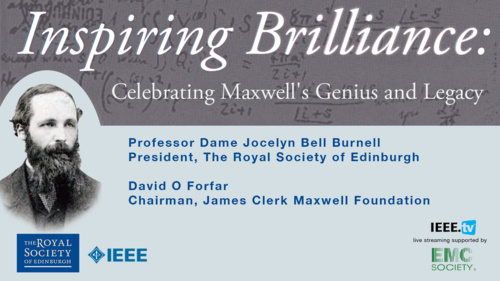
Inspiring Brilliance: Celebrating the Legacy of James Clerk Maxwell
Current President of The Royal Society of Edinburgh, Professor Dame Jocelyn Bell Burnell, introduces the RSE and the live event. David O Forfar, Chairman of the James Clerk Maxwell Foundation, warmly welcomes the panel of speakers.
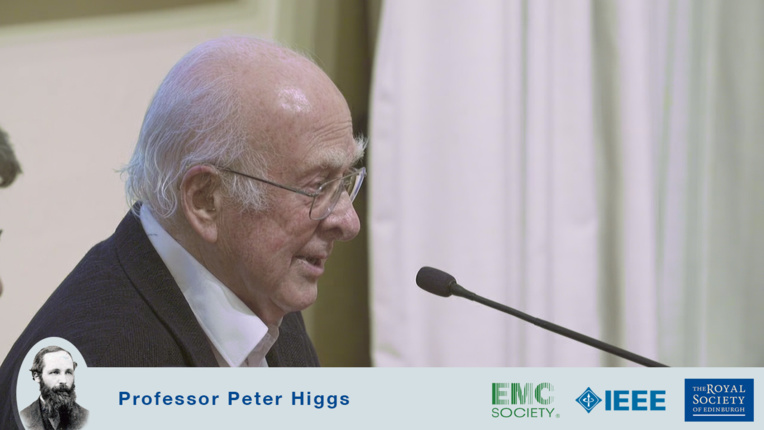
Maxwell's Equations: The Tip of an Iceberg (Peter Higgs)
Professor Peter Higgs discusses Maxwell's genius and legacy at the Royal Society of Edinburgh's 2015 IEEE/RSE event, "Inspiring Brilliance: Celebrating Maxwell’s Genius and Legacy."
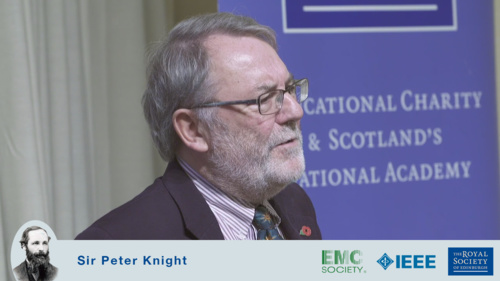
Inspiring Brilliance: Maxwell, field theory and the road to relativity and quantum theory
Sir Peter Knight of the Quantum Measurement Institute, UK National Physical Laboratory, Kavli Royal Society International Centre, and Imperial College London, speaks on the origins of the study of light, including Newton, Faraday, Hertz and more.
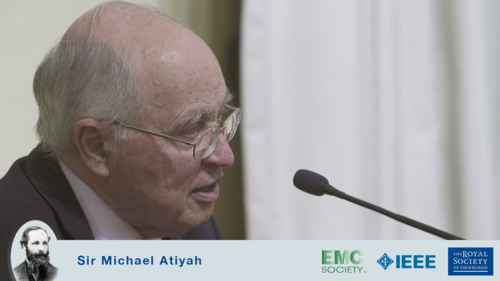
Inspiring Brilliance: Clerk Maxwell's Influence on Mathematics
Sir Michael Atiyah of the University of Edinburgh, Trinity College, and The Royal Society of Edinburgh, speaks on Maxwell's diversity in his path of disciplines. Sir Atiyah explains Clerk Maxwell's profound influence on the field of mathematics.
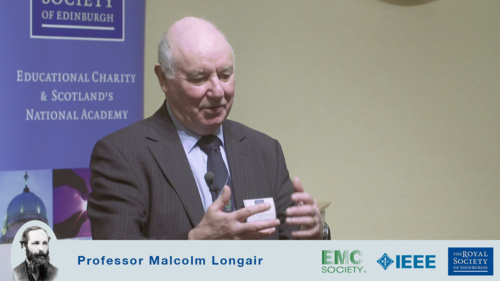
Inspiring Brilliance: Multi-disciplines of Maxwell's Research
Professor Malcolm Longair presents the key themes and topics that James Clerk Maxwell studied, often simultaneously, such as his mathematical papers, theory on electricity and magnetism, colour, Saturn's rings and more.
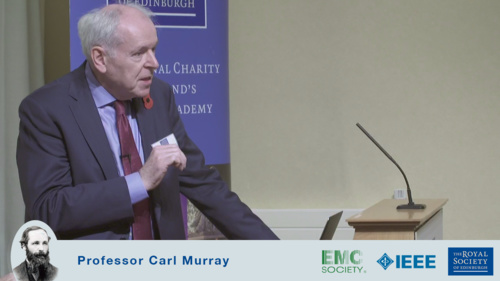
Inspiring Brilliance: The Impact on Astronomy of Maxwell's Adams' Prize Essay
Professor Carl Murray of the School of Physics & Astronomy at Queen Mary University of London, speaks on Maxwell's impact on the field of astronomy. Specifically, Maxwell's drawings, and his analysis on Saturn's rings in relation to planetary systems.
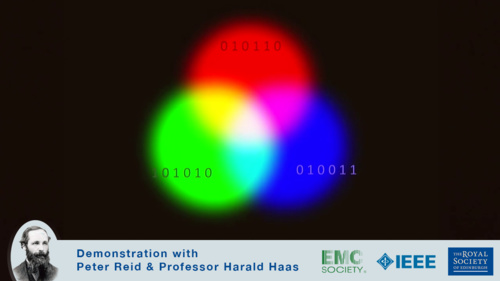
Inspiring Brilliance: James Clerk Maxwells vision and his influence on wireless communications
Peter Reid of the University of Edinburgh demonstrates how Maxwells studies of optics shaped our understanding of how we see the world. Professor Harald Haas highlights his influence on wireless communications and demonstrates light projections.

Inspiring Brilliance: The Impact on Engineering of Maxwell's articles on Structural Mechanics
Professor Iain MacLeod explains a brief history of Structural Mechanics, the mathematical logic and processes behind the engineering of buildings, bridges, ships, aircraft and machinery, and demonstrates Maxwell's significant role in the field.
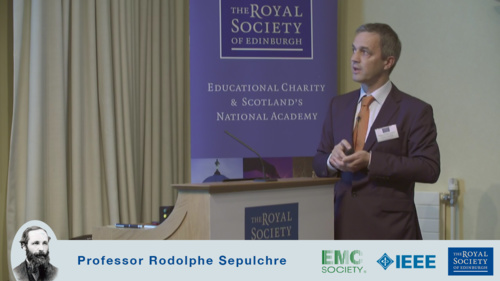
Inspiring Brilliance: The impact of control theory and cybernetics of Maxwell's paper: On governors
Professor Rodolphe Sepulchre of the University of Cambridge presents his talk on Maxwell's infamous paper On governors, and why control theory deserves the paternity of Maxwell. He continues to explain the background and foundation of control theory.
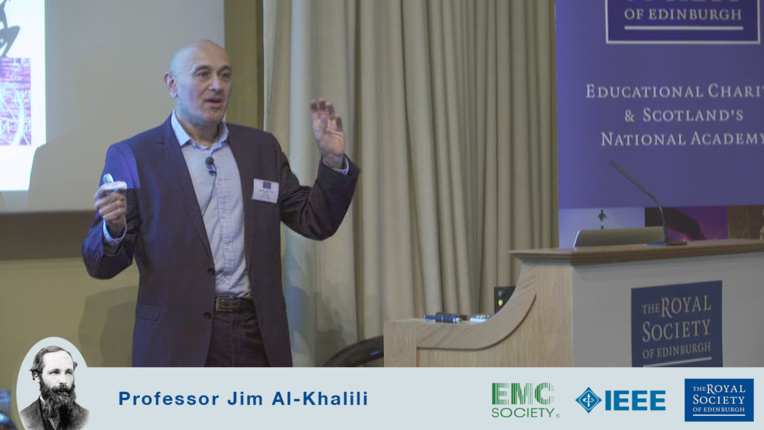
Inspiring Brilliance: The Impact of Maxwell's Demon on Information Theory and Computing
Professor Jim Al-Khalili of the Department of Physics at the University of Surrey speaks on Maxwell's bold stance on the 2nd Law of Thermodynamics, otherwise known as his hypothetical "demon" that challenged the popular understanding of entropy.
From Maxwell's Equations to Modern Electromagnetics and Antenna Engineering Marvels
The collective works of many scientists and engineers were captured in Maxwell, Hertz, Marconi and Shannon's pioneering contributions to modern communications technologies. Professor Samii gives us the rundown
IMS 2015: Maxwell's Equation - The Genesis
Clerk Maxwell first published what we today call Maxwell's equations in the Transactions of the Royal Society in January 1865. This session celebrates the 150th anniversary of that publication.
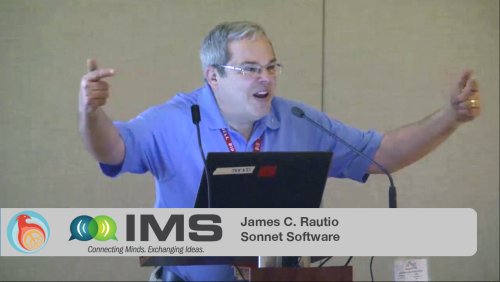
IMS 2015: Four scientists who saved Maxwells Theory
Inspired by the work of Ørsted, Faraday, Ampre, and many others, Maxwell's equations form the basis for our entire field. Newton said, "If I have seen further it is by standing on the shoulders of giants." Maxwell is our giant.
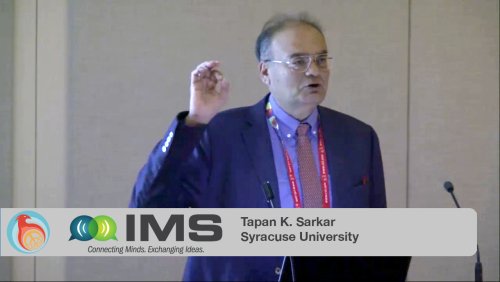
IMS 2015: Evolution of Maxwells Theory of Electromagnetism
The objective is to illustrate how Maxwell came to his mathematical constructs of the work done before him by Oersted, Ampere, Faraday, Gauss and so on, into a concise and precise mathematical form.
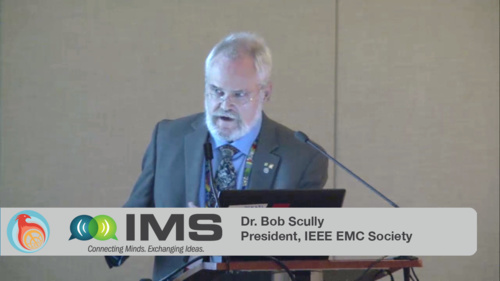
IMS 2015: Maxwells Legacy: The Heart and Soul of the EM Discipline
This presentation provides an examination of Maxwell's original equations, and their relationship to the set of equations that survived the transformation process.